Zephyr
Nasal swab sequencing for respiratory pathogen surveillance
Piloting a promising approach to pathogen early warning
Reliable monitoring of respiratory pathogens is central to biosurveillance, as respiratory pathogens pose among the largest pandemic risks. However, we currently lack systems that provide sensitive real-time monitoring of many known and unknown respiratory threats. Routine swab sampling and sequencing could fill this gap: Respiratory swabs are frequently used in healthcare settings across the world, and have been shown to sensitively detect many respiratory pathogens.
While the US government has created a routine nasal swab sampling program in the aftermath of COVID-19 through its Traveler-based Genomic Surveillance (TGS) system, TGS relies on targeted assays, including PCR and amplicon sequencing, which detect only known pathogens. Expanding surveillance to cover other respiratory pathogens could be achieved through metagenomic sequencing, an approach that identifies all pathogen genomes in a sample. NAO modeling further suggests that applying metagenomic sequencing to routinely collected pools of swab samples could provide continuous, cost-effective and pathogen-agnostic early detection.
Given this potential, the Nucleic Acid Observatory is piloting a swab-surveillance program, called Zephyr.
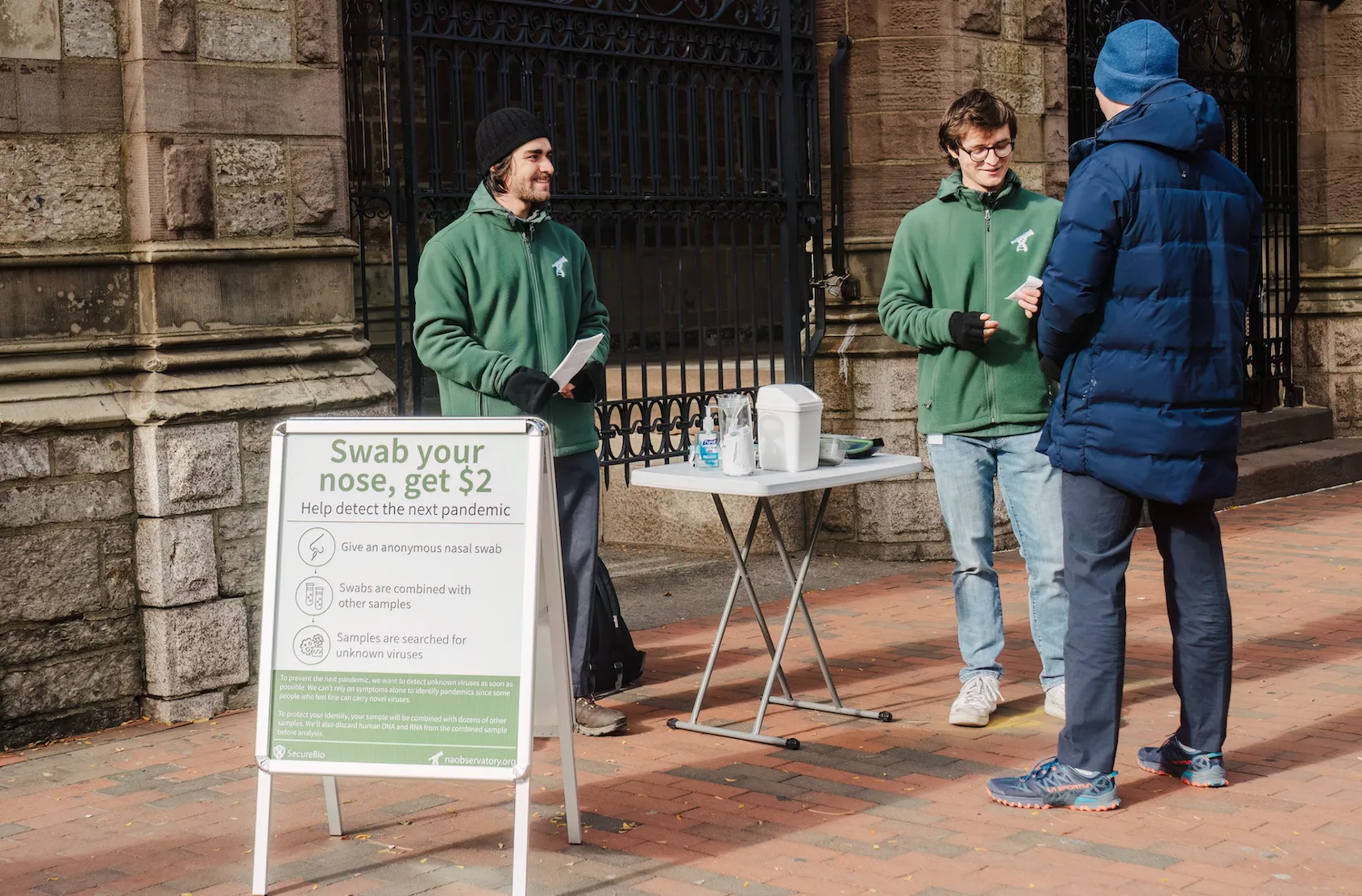
NAO staff now collect swab samples most weekdays
Complementing wastewater surveillance
The main effort of the NAO’s pathogen surveillance is our CASPER system where partners collect wastewater from across the US, which is sequenced and analyzed for both known and genetically engineered pathogens. While CASPER provides robust surveillance of a large swath of pathogens, detecting some respiratory pathogens in untargeted wastewater sequencing data is challenging: the total number of pathogen reads can be very low, requiring large amounts of sequencing for reliable detection.
Many of these pathogens can be readily detected in nasal swabs of infected individuals. Based on a pilot program run in the 2024/2025 infectious disease season, it is possible to collect a large number of samples with a small number of staff, enabling the detection of many respiratory pathogens. The collected data suggests that for a given level of funding, swab sequencing could detect respiratory pathogens earlier than untargeted metagenomic wastewater sequencing.
Establishing routine swab sampling and sequencing
By setting up Zephyr, we want to further explore the value of swab-based pathogen surveillance. Zephyr serves both as a large-scale pilot and, if successful, as a template for wider implementation of this new surveillance modality. In running this pilot, we both aim to assess how valuable swab sequencing data is for pathogen surveillance, and how challenging the actual operations of a swab sequencing program are.
The results of Zephyr can be found on our dashboard, where we track the total number of samples collected, number of samples collected per hour, and the kinds of viruses we are detecting in our samples. All sample collection, processing, and data analysis are conducted under IRB protocol #24-08-633-1971, approved through BRANY. In line with this, we are working to make all sequencing data generated through Zephyr publicly available on SRA (PRJNA1379685), except for human genetic material that we remove to ensure privacy.
We believe programs like Zephyr could play a large role in strengthening public health and biosecurity in cities beyond Boston. To assist other efforts, we aim to make all Zephyr resources public:
Approved IRB protocol (#24-08-633-1971)
Basecalling pipeline for Oxford Nanopore data (basecall-workflow)
Taxonomic and viral identification pipeline (nao-mgs-workflow)
Protocol for concentration and total RNA extraction of viruses from nasal swabs
SMART-9N amplification enabling rapid nanopore sequencing of RNA viruses
If you are interested in learning more about Zephyr, please contact us at info@naobservatory.org!